Showing posts with label *Gamecube. Show all posts

Wednesday, October 12, 2016

Luigi's Mansion

Nintendo - 2001 - Gamecube

Man Luigi's Mansion is a weird game. On paper, this game shouldn't even be good. Luigi explores a haunted mansion and vacuums ghosts? It's a type of game that's really easy to make wrong or design in a way that isn't fun for the player. It's really the type of game that only a developer like Nintendo could make

This was my first time playing Luigi's mansion since it launched back in 2001 which is fifteen years now. Crazy. Man I had forgotten how short this game is. A friend and I sat down to play through it one afternoon and we finished it in one sitting. If you don't dawdle around too much, you can finish this game in about 5 hours. Which is fine but unusually short for other Nintendo games of this era. The game still holds up pretty well, especially graphically considering the game is 15 years old now. The relative small size and scope of the mansion allowed the artists, modelers and animators to pour in a lot of detail into each of the rooms of the mansion which is still impressive today, especially considering this was a launch title.

Just about every encounter with a ghost boils down to trying to expose their weakness so that they can be vacuumed into Luigi's ghost capturing machine. Even 15 years later, this still feels like a unique idea. The closest elements in common with any other game are the light use of puzzle solving elements when trying to figure out how to expose the ghost's weakness. Even though the game still feels fresh it isn't without faults. I wouldn't criticize it for being too short, but I will criticize it for obvious attempts to pad out its length. Near the end of the game, Luigi is forced to trek back and forth from the roof of the mansion to the basement which takes roughly 5 minutes one way and there isn't anything new or interesting presented to you along the way. Now as an adult I can recognize when a game is stretching for time and I'm not sure why developers feel this is necessary. To me, artificially stretching a game's length in a boring or repetitive way is always way more egregious of a sin than just actually being short

Summary
Luigi's Mansion is a short but fun foray into a haunted house that's more about the atmosphere and elements of scariness than actually being scary, which I can appreciate. I've yet to play the Luigi's Mansion: Dark Moon which is a 3DS exclusive sequel released in 2013 as part of Nintendo's "Year of Luigi" promotional event. I've heard good things about this game and I may need to check it out soon. As the popular internet saying goes: "The Year of Luigi never ends"

Sunday, September 11, 2016

Super Mario Sunshine

Nintendo - 2002 - Gamecube

I've been revisiting some of the Gamecube's greatest hits recently so I of course had to play through 2002's Super Mario Sunshine. Like Luigi's Mansion, this was the first time I had played through this game in maybe 15 years and this game holds up too, but man does it have some giant flaws. 

First of all, this is probably the most dialogue and cutscene heavy of any of the mainline Mario games. Which in and of itself is not a bad thing but Super Mario Sunshine opens with about 15 minutes of unskippable cutscenes and dialogue before you're finally set free in Delphino Plaza. 15 minutes is an eternity for a Mario game where I really don't care about the story or Mario's motivations. I just want to run and jump around. Although the whole FLUDD and pollution clean up is a very weird angle for a Mario game, I think the hover, turbo boost and rocket jump are a good addition to the 3D Mario moveset. The first few levels with wide sprawling areas and lots of upward vertical movement are a perfect compliment for the new moves given to Mario with FLUDD. The hovel nozzle allows you to steady your aerial approach when trying to land on the small bouncy cables and the rocket boost allows you to get up high quickly if you fall off. I think there's some decent level design on display here, but let me highlight one of the worst and most egregious errors in player input mapping I have ever seen. Ricco Harbor and Pinna Park both feature vertical AND horizontal chain link fence link surfaces that Mario can climb on. While Mario is climbing on a vertical fence, his A button is mapped to "jump" while his B button is mapped to a punch command which can hit enemies climbing on the opposite side of the fence. While Mario is hanging from a horizontal fence surface, his A button is mapped to the punch command while his B button LETS GO OF THE FENCE. NO, NO, NO! Bad! Bad! Bad! The horizontal controller mapping is the exact opposite on the vertical controller mapping! Pinna Park has vertical fences placed right next to horizontal fences with enemies crawling on either surface. I can not tell you how many times I accidentally fell off of the level while attempting to punch an enemy with the same button I had just pressed a second ago. Terrible. 

This game's other huge problem is with the concept of a difficulty curve. The curve is all over the place with this game. In some levels, the stars get easier as you go. This is most noticeable at the end of the game where you're required to paddle through lava and jump through clouds in a relatively difficult platforming challenge. Then you fight Bowser which has got to be one of the easiest things to do in the entire game. I beat him in about 30 seconds on my first try. The other noticeable difficulty spikes are with the "secret" stars. The ones that require you to complete a platforming challenge without the use of FLUDD. I think the idea here is that FLUDD makes some of the platforming too easy. You can sort of use FLUDD to compensate for mistimed or misspaced jumps, so taking FLUDD away would lend for some interesting platforming challenges. The problem is that you get so used to using FLUDD to "cheat" that the platforming becomes that much more hard when its taken away from you. Add in the fact that making a platforming error on one of these stages usually results in Mario plummeting to his death instantly and now you've got some really unforgiving and incredibly challenging stages. Which is fine. But these "secret" stars are relatively much, much more difficult than most other stars.

Okay one last nitpicky thing. Remember Hotel Delphino on Gelato Beach? It was the one infested with a bunch of Boo ghosts. It was actually my favorite level as a kid. It was my least favorite this time around. There's a star that requires you to get Yoshi up to the attic to get past some Boos since they can only be defeated by being eaten by Yoshi. It's possible to fall through the attic into a room that you can only exit by opening a door. As far as I can tell, you cannot open doors while riding Yoshi. Which means you have to leave him in the room you fell into and he's trapped until he despawns, which is on a timer. The problem is a new Yoshi won't respawn until the old one dies, so if you fall into these rooms, you're basically stuck waiting two or three minutes for your Yoshi to die. Bad design. Oh also the underwater levels still suck in Sunshine.

Summary
I know I've done pretty much nothing but complain about Super Mario Sunshine, but I still think it's a good game. I mean if you compare it to other Mario games, it's probably average. But in the grand view of all video games, it's still good. It's worth taking another look at if you played it 15 years ago like I did, but I'm not sure I could recommend this one for a new player. It's far from Mario's best offering. For that, check out Super Mario 3D World.

Saturday, January 9, 2016

The Legend of Zelda: The Wind Waker

Nintendo - 2002 - GameCube/WiiU

See also my Top 10 Zelda Games

Happy new year! I hope everyone had a fun and safe holiday break. If you haven't done so already, you can check out my best games I played in 2015 list right here. You may also be interested in my top 10 Zelda games list or my top 10 Star Wars games lists as well. Anyway, on with the review

When replaying The Wind Waker recently, it really struck me how well this game has aged. I think this game could literally come out tomorrow and it would have an amazing reception, despite the fact that this game is nearly 15 years old. Now I wasn't playing the HD remake on WiiU either, I'm talking about the original on GameCube. The cell shaded graphics which had a mixed reception on release now blend right in with the modern "toon" style graphics popularized by recent indie titles. This graphic style also allows for what I believe is the most expressive and emotive iteration of Link in any Zelda title. I love seeing the suspicion or anger or happiness that was so clearly readable on Link's face.

The Wind Waker finds Link exploring the open seas on a small sailboat in a very vast and open game world. The Wind Waker especially excels at the same thing a lot of the other Zelda titles do well which is immersive world building. The Wind Waker's world feels immersive and real because the characters and events in the world are well written enough to make it feel that way. There's a part of the game not too far into Wind Waker where Link needs to crawl through a maze of tunnels underneath Windfall Island. There's nothing in the main storyline of the game that will specifically or directly prompt you to crawl through these tunnels, this is just a hidden optional side quest. Once you reach the end of the tunnels, you'll find a treasure chest with a pictograph box which is an item that kicks off several more sidequests, but what struck me about the pictograph quest was the inclusion of some readable text next to the treasure chest where you find the pictograph box. The text explains that there was a thief who was imprisoned presumably for stealing the pictograph box, and who dug a series of tunnels below Windfall Island in an attempt to find a way to escape the prison cell. This was pretty cool to me, and a neat example of the high quality of writing and world building on display in the Wind Waker. The game could have just made you crawl through a maze and then simply given you the pictograph box, but the fact that they included this little story behind it that justifies the level design in a believable way adds some realism and fidelity to the world in the Wind Waker

Wind Waker Video Review

Summary
The game is also not without its faults. I think the stealth section that occurs near the beginning of the game is really tedious, too long and one of the weakest points of the game. I can remember having a poor first impression of this game and thinking on my first playthrough how dull this stealth part of the game was. And then right after introducing stealth to you, the game promptly drops it and never revisits it for the rest of the game. Plus there's a few too many mandatory fetch quests with a repetitive and boring sailing sections near the end of the game (which was I think partially remedied in the HD WiiU version). But even with its faults, the Wind Waker is one of the strongest Zelda titles out there, and a perfect place to start if you've never played a game in this series before.

Friday, October 3, 2014

Resident Evil

Capcom - 2002 (1996 Original) - GameCube/Wii/PS3/X360

Ahhh, October. October has always been one of my favorite months. Maybe it's because I was born in the beginning of the month, or maybe it's because October means football season is in full swing or maybe it's because the oppressive Florida weather where I live starts to cool down a bit and you can go outside again without feeling like you're going to die. Or maybe it's because October is home to Halloween, which has become one of my favorite holidays in my adult life. Aside from eating candy and dressing up like ridiculous characters, the fact that Halloween is a sort of celebration of fear and scary things has always been a novel concept to me. Last year, I observed Halloween by watching a bunch of horror films and exploring specifically why I did or did not find them scary. This year, I'm planning to do the same thing here, but with games. I'm going to kick things off with one of the most obvious and well-known horror games of all time, but I promise in the coming weeks I'll cover some horror games you probably haven't played before. Also if you're looking for other horror titles to try, check out anything I've labeled with the horror tag so far. All of those titles are interesting in their own way and definitely worth a look with Silent Hill 2 being a particular favorite of mine.

The original Resident Evil made its debut on the PS1 in 1996 and is considered to be the genesis of the survival horror game genre. It was very well received critically and commercially and it of course spawned many sequels, spin-offs and movie tie-ins. Starting with Resident Evil 4, recent entries in the series have been more action/shooter than survival horror, but the original Resident Evil is certainly true survival horror. As important and influential as the original is, the game I want to specifically talk about is the 2002 remake for GameCube that was then ported to a bunch of other consoles. The 2002 remake contains completely redone visuals and cutscenes, alterations to gameplay, completely different puzzles and re-recorded voice acting, sound effects and music. This sounds like total blasphemy, especially to remake a game as iconic as the original. But the remake is SO well done; it's faithful to the vision of its predecessor and it's a testament to the quality of the remake that the remake is arguably even more well received than the original. Aside from more immersive sound and graphics, probably the most important thing the remake did was re-record the voice overs. The voice acting was, well, pretty terrible. I think the enhancements made in the remake enable this game to age a little more gracefully and stand the test of time as a horror game masterpiece.

If you've ever played any of the other entries in the Resident Evil series, you know that the story is kind of ridiculous and throw away. There's all sorts of plot holes and inconsistencies and it can get pretty absurd at times. Most of my other favorite horror games use excellent writing to help create their creepy mood, but not really so with Resident Evil. What it lacks in storytelling, it makes up for with superb audiovisual presentation and excellent game design. One of the first unusual things you'll notice when playing the game is that it uses a fixed and stationary camera. The game is still rendered in full 3D, but the camera never moves, only the the player and enemies do. This can be a little disorienting at first, especially when changing scenes, but I'm surprised I haven't seen this elsewhere in other Survival Horror games. It makes the game feel very cinematic and gives the designers complete control over exactly what they want the player to see. In first person games or games with an adjustable camera, the designers have to design set pieces and jump scares around knowing or guessing where the player's camera will be. Resident Evil is freed up to design its scares however it pleases, and it does so very well.

Resident Evil does a great job of not only creating creepy atmosphere with its audiovisuals, but also by creating stress and nervousness through gameplay. Encountering an enemy in is scary in its own right, but that fear is also accompanied by the stress of considering how to deal with the enemy. You may have a pistol, but ammo is limited. Should you still shoot it? Knives don't consume ammo, but are also more risky as you have to get close to the enemy in order to kill it. And even if you do manage to "kill" a zombie, it will actually eventually reanimate and become stronger and faster. You can prevent a zombie from reanimating by burning their corpse, but that means you'll have to carry around kerosene and a lighter which take up precious inventory slots. Burning corpses will also consume kerosene which is preciously finite resource. Is the corpse in a key corridor that you'll have to walk through frequently? It might not be worth your kerosene. And if ammo or health are low, sometimes the best option may be to simply run away.

Another smart game design choice was the limitation of the player's inventory slots. You'll eventually find a giant crate in the game that can store all of your items, but you can only take so many of them with you at a time when you leave. You'll have to make strategic decisions about how many healing items you want to bring, how much ammo you want to bring, whether or not to bring the kerosene/lighter and you'll also want to think about how many inventory slots you want to keep open in case you find something interesting while exploring the mansion. There's also a finite number of saves you can make while playing Resident Evil, which is a really interesting mechanic that I'm surprised more games haven't copied. Your character in the game saves their progress by typing on an old-fashioned typewriter, but using a typewriter requires ink ribbons which are then consumed. When you burn through all of your ink ribbons, you can't make any more saves until you find more ribbons in the mansion. This keeps the player from just killing a few enemies and quickly running back to a save their progress. There's an ample amount of ink ribbons to find in the mansion as to not make the number of saves an annoying issue, but it still makes you think twice before making a save with minimal progress. Very smart game design.

Summary:
Resident Evil is a horror game classic, and the remake is a masterpiece. You absolutely must play this if you're a horror game fan, but if you call yourself that you probably already have. For those looking to test the waters of the survival horror genre for the first time, the Resident Evil remake is a great place to start. It excellently builds and maintains tension through superb audiovisual presentation and smart game design. In the most Capcom of moves, I hear they're remaking the remake for next-gen consoles and PC and it will be out early 2015. I think this is just going to be an "HD remaster" of the remake, but this will still hopefully give more people a chance to play this game. Shinji Mikami, the creative director of Resident Evil, also has his latest game "The Evil Within" coming out later this month. From what I've seen of the game so far, it looks very interesting. Hopefully he can recapture the terror and suspense he created so well initially with Resident Evil

Friday, February 28, 2014

Resident Evil 4

Capcom - 2005 - Gamecube/PS2/PS3/Wii/X360/PC

In order to help commemorate the release of the “Ultimate HD Edition” of Resident Evil 4 on Steam this week, I figured I’d post about how awesome this game is. It's actually difficult for me to put my finger on why I like this game so much. On paper, it seems like a game I would absolutely hate. The story is pretty much ridiculous. The puzzles feel tacked on and unnecessary. There's instant death quick time events in cutscenes. All things I hate. Plus it's a shooter, and I'm not usually enthralled with action/shooters. But somehow this game really won me over and became one of my favorites.

Resident Evil 4 marked a huge shift in the franchise's gameplay. RE 1-3 were really more pure survival horror games. Ammo was scarce. Enemies were scarce, which made it more intense when you encountered one. Aiming was kind of awkward which gave a real sense of vulnerability. The emphasis was on atmosphere and trying to creep the player out. I liked these games, especially the first Resident Evil. RE4 is a very different kind of game. There's enemies all over the place, the controls are tight, and the emphasis is on the shooting and action. It's a different kind of fun. It still does atmosphere sort of well through the first half of the game, but kind of abandons it through the second half in my opinion.

What I think this game does very well is variety. Variety in enemies, variety in weapons, variety in locations and so on. While I think RE4 does some sections of the game better than others, at least you never get the sense that you're doing the same thing over and over which I frequently get while playing shooters. There's the atmospheric lonely feeling of the village in the beginning of the game, the creepy cultists in the castle, the unnerving bizarre science experiments in the laboratory and the over the top action sequences near the end of the game.

There are lots of unique and memorable experiences in RE4. There's everything from being trapped in a cabin with legions of zombies trying to break in to running from an invisible monster through dimly lit sewers. There's even epic gigantic boss fights and a few vehicle sections as well. It's not as nerve-wrackingly scary as the first RE games, but there are a few jump scares scattered throughout RE4. There's a sort of fun metagame of deciding which weapons and items you'll take with you with limited inventory space. And deciding which guns to upgrade and which upgrades to purchase is fun too.

Summary:
It's just good old zombie killing fun. Check it out

Friday, February 21, 2014

Paper Mario: The Thousand Year Door

Intelligent Systems (Nintendo) - 2004 - Gamecube

(On my Top 10 Favorite Games list)

One of my all-time favorite games. I’m madly in love with this game and I’ve replayed it more times than I can remember now. This game somehow gets overlooked and forgotten quite a bit despite the fact that it’s a Mario game. Probably because hardly anyone owned a Gamecube and even fewer of those people were into RPGs. They unfortunately missed out on a fantastic game.

The story seems kind of formulaic at first. The game begins, predictably, with Princess Peach being kidnapped, but not by Bowser. You find out shortly that she was kidnapped by a group of people who call themselves the x-nauts. The x-nauts’ leader, Grodus, kidnapped Peach because he believes there is a connection between her and opening the titular Thousand Year Door. Legends tell of a great treasure hidden behind the Thousand Year Door that Grodus becomes obsessed with finding.

The story and writing strikes a perfect balance between being light hearted and fun but also not being too childish or silly. I think the writing might be one of my favorite things about the game, I think it’s one of the best-written games I've ever played. Which sounds ridiculous considering it’s a Mario game aimed at kids, but the writing is really quite humorous and charming. It’s very self aware and often breaks the fourth wall to communicate directly to the player. The characters are well defined and are brought to life through excellent writing and exaggerated cartoony animations. Even though I've played through the game a bunch of times, I still crack a smile at some of the silly jokes and running gags.

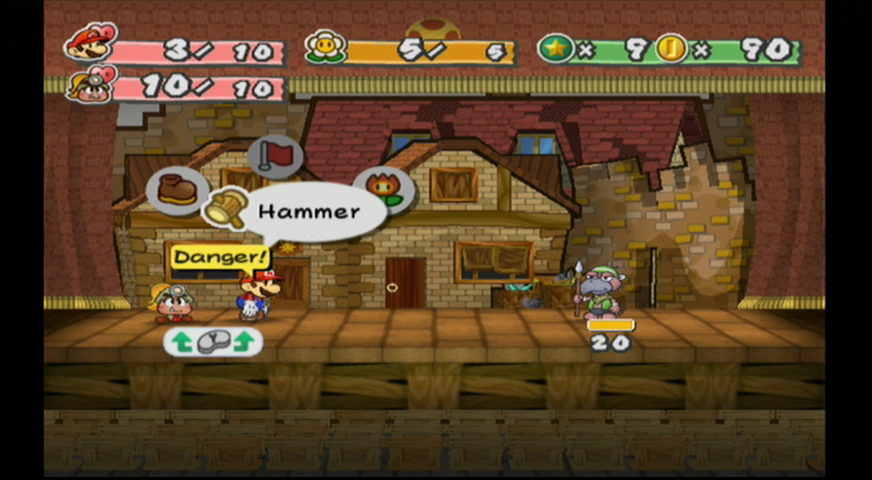
The gameplay is typical turn based JRPG combat, but with an additional skill-based “action/timing” mechanic that can boost your attack power or defense if executed correctly. For instance, pressing the A button just before Mario is hit by an enemy will decrease the damage he takes. Or if you’re feeling bold, you can try to press the B button before an enemy attack to counter and inflict damage on the enemy, but the required timing for pressing the B button is more precise. Mario can be assisted in battle by several companions that he encounters throughout the story. Each companion has their own stats and skill set and can also be upgraded by finding hidden items throughout the game. Each time Mario levels up, you can either increase his HP (Heart Points), FP (Flower Points, required for special attacks) or BP (Badge Points). Badge points are probably the most interesting to upgrade because they allow Mario to equip badges that grant him extra abilities. For example, you could equip the Double Dip badge which allows Mario to use 2 items per turn, providing that you've already found the Double Dip badge and have enough BP to equip it.

The BP system keeps the battles interesting because you’ll constantly be experimenting with new badge setups in battle and the “action/timing” mechanic keeps you engaged trying to learn how to defend each enemies’ attack timings.The pacing is also excellent, you’ll never feel like you’re doing the same thing twice. One chapter has you entering into a wrestling tournament, while another has you solving a series of mysteries while riding a train.

Paper Mario: The Thousand Year Door Video Review

Summary:
The only drawbacks I can think of with this game are with the difficulty. It’s pretty easy. It’s more of an intro to RPGs, so if you’re used to playing these kinds of games, you’ll probably breeze through it. Also the game starts a bit slow. The first two chapters, compared to the rest, are kind of bland. But stick with it, the game gets better the father into it you get. I think it’s worth tracking down a Gamecube and a copy of this game to play it. Or if you know me personally, ask me and I’ll let you borrow my copy. If you only take one of my recommendations seriously, let it be this game