Friday, March 28, 2014

Towerfall: Ascension

Matt Thorson - 2013 - Ouya/PC/PS4

(On my Top 10 Favorite Games list)

I can't remember the last game I played that was this much pure fun. And I don't think I've laughed and screamed at the TV with any game this much outside of Smash. Towerfall is a fast paced brawler/platformer/shooter game. It guess it kind of defies genre classification. I suppose you could file it under party game? It plays best multiplayer, that's for sure.

Towerfall is kind of like Smash, except every hit is a one hit kill. And the levels wrap around Pac-Man style. And every player has projectiles. So I guess not really like Smash then, but it's similarly as fun. It's easy to pick up and play, the only buttons are jump, shoot and dodge. Moving your character around and learning the game is quick and easy, but like any good game, there's a deceptive amount of depth. You don't always want to shoot when your opponent is expecting you to because then he will dodge and catch your arrow. You also don't want to mindlessly fire away arrows at your opponent because ammo is limited and your opponent can pick up any stray arrows that miss and fall on the ground. You also have to be mindful of opponents that get up close to you as jumping on an enemy's head is also a one hit kill.  You also have to be aware of the edges of the screen and remember that the level wraps around. It's possible to get easy kills on unaware opponents by shooting back across the screen at an enemy on the other half of the level or jump down the bottom of the stage to head stomp somebody on top

There are also powerups that appear throughout the match that can give you arrows that explode on impact, bounce off walls or cut through the stage. Matches are quick, usually averaging about 30 seconds per round, so you'll want to race to pick up powerups as you see them. There are also powerups that can grant you invisibility, flight or trigger arena traps to try to kill your opponents. There's usually a lot happening on screen all at once and matches can get a little hectic, but I mean that in the best way possible. At the end of each round, there's an instant replay system that shows the final kill of the game. This is actually a pretty cool feature because things often happen so quickly that you'll miss how someone died. There's also a good variety of levels that have different powerups, different layouts and different terrain. You can also randomize the rules of Towerfall each round for maximum ridiculousness. One of my favorites was playing under a rule that doesn't show you how many arrows you have left combined with another rule that instantly kills you if you try to fire an arrow when you have no ammo left. The amount of customization and variety in Towerfall is a huge plus

As stated before, Towerfall definitely plays best with friends. The single player is alright for what it is I suppose, but if you're buying Towerfall, you're getting it to play with other people. Towerfall supports up to 4 simultaneous players and I found that 4 seemed to maximize the fun, hilarity and craziness of the games. Towerfall doesn't support online play of any kind which is really unfortunate because I think a game like this could really be fun online. At the same time though, this game is really fun to share with other people in the same room, yelling, laughing and screaming at the TV and at each other. I wouldn't be surprised to hear that this game eventually gets some sort of online support though, I would imagine that's going to be an often-requested feature. The only other thing that might be limiting this game is the hardware. This game plays best with 4 people. I happen to have 4 USB controllers for my PC, but I'm pretty sure I'm in the minority. And I don't think a whole lot of other people have 4 Ouya controllers or 4 PS4 controllers lying around either.

Towerfall: Ascension Video Review

Summary:
If you've heard the positive buzz about this game, it's true. Believe the hype. This game is well designed, fun and fast paced. It's the early leading candidate for my 2014 game of the year. Yes, I know this technically came out last year on the Ouya. But now it's out on platforms that people actually widely own and use, so I hope this game gets lots of exposure in the near future. Check it out if you want a good, fun party game to share with friends

Friday, March 21, 2014

Risk of Rain

Hopoo Games - 2013 - PC

Risk of Rain is a 2D side scrolling roguelike shooter. Imagine if Spelunky had a bigger emphasis on combat. The object of Risk of Rain is to complete all six of its levels without dying. All of the levels in Risk or Rain are pseudo randomly generated and the monsters and powerups in the level are also randomly generated. In order to advance to the next level, you must find and activate the teleporter hidden in each level. Activating the teleporter summons the level's boss monster, which is also random, and many hordes of enemies. You'll want to be sure you've found enough powerups in the level so you're adequately prepared to fight the boss when you activate the teleporter. But don't spend too much time wandering around looking for powerups because every five minutes or so, the game's difficulty level automatically increases, spawning more tougher and stronger monsters. It creates a nice little time management risk/reward metagame similar to the one that's present in Spelunky. There's also light RPG elements in the game where killing monsters gives you EXP and money. EXP is used to level up your character and get stronger while money can be used to unlock containers scattered around the level to obtain new powerups and items.

Risk of rain can be tackled solo or cooperatively and co-op mode can be played over the internet or couch co-op style. I played the game all three ways, and I must say I enjoyed playing the game co-op more than single player, but the co-op exposes some of the game's flaws. First off, the game doesn't seem to adequately balance the difficulty to account for the extra player(s). It seemed noticeably easier to me co-op as opposed to single player. The other problem is that when one player dies, the other player is left to fend for themselves which isn't really that fun for either player. When one of us died, we usually just restarted the game.

I usually prefer playing games like this couch co-op style, because it's easier to share the experience with another person when they're actually physically present in the room. But the couch co-op mode here has a few problems. The game in general can become a bit hectic with bullets and powerups and enemies flying all over the screen. But when 2 or 3 players all share the same screen, it can become a bit hard to follow and tell what's going on. Also because there's only one camera in the couch co-op mode, all the players have to make an effort to stick together which can be hard to coordinate. The preferable way to play this game seems to be the over the internet multiplayer so that each player has their own camera and is free to explore as they please. Although even the internet multiplayer was a bit tricky to set up initially. You have to figure out your IP and share it with your friends and all that. I had to change some firewall settings and forward some ports as well. The actual implementation of the internet multiplayer here seems a little bare and clunky. It kind of reminded me of how internet gaming was in the late 90s. Maybe I've become spoiled by all these games that handle internet matchmaking with friends very gracefully and smoothly

The controls for Risk of Rain are pretty simple. The default character can jump, shoot, dodge and has two special shooting abilities which are on a cooldown. There are other characters in the game that are unlockable and a slightly different moveset, abilities and statistics.

Summary:
Boiled down to its simplest mechanics, the game is just shooting enemies, looking for powerups and waiting for your cooldowns to recharge. But Risk of Rain is a game that really does feel like it's greater than the sum of its parts. Always competing against the clock gives a constant sense of urgency. Leveling up and unlocking new powerups and items lends a real sense of power and progression throughout the game. Somehow surviving against an impossible number of enemies on screen gives a great sense of accomplishment. Risk of Rain is a mechanically and graphically simple game, but you may end up spending more time than you would think playing it once it gets its hooks into you. Check it out

Friday, March 14, 2014

Zero Escape: Virtue's Last Reward

Chunsoft - 2012 - Vita/3DS

Zero Escape: Virtue's Last Reward is the sequel to 999, which I played for the first time last year. If you're not familiar with these games, just imagine the Japanese anime interpretation of the movie Saw made into a graphic novel/videogame. And then sprinkle some puzzles on top. Basically 9 people wake up together locked in a room with no memory of how they got there and are forced to play a game riddled with deathtraps in order to find a way out.

Despite my grievances with 999's game design, the quality of the writing enticed me enough to play its sequel. Thankfully, VLR corrects most of the frustrating game design from predecessor. Like 999, VLR has a non-linear story with branching decision points and multiple different endings are required in order to get the "true" ending. VLR implements a much needed "time travel flowchart" where you can skip to any decision point or puzzle you've already encountered in the game, so you don't have to completely restart the game every time you get an ending. Honestly, if 999 had this feature, I could and would have forgiven a lot of that game's faults.

There are numerous UI enhancements to VLR as well. In 999, if you needed to consult your notes when solving a puzzle, you had to flip back and forth between menu screens. I can remember sarcastically thinking "If only the DS had two screens and I could look at both of these things at the same time...". Thankfully, the developers have now taken advantage of the DS' hardware and corrected this annoyance.  There's also now a built in note taking feature which allows you to doodle or jot down quick things that you think may be important later in the game. All puzzle solving sections are now fully three dimensional rooms with a rotating camera rather than a 2D screen, which allowed me to get a better sense of the rooms I was in. Nearly all of the text in the story sections has been supplemented with voice acting. When I first heard this, I was kind of nervous because I've found that bad voice acting can take me out of a game really easily. But I found that the voicework in VLR to be pretty good quality. It really enhanced the game and added more flavor to the characters. I kind of wish 999 was voice acted after playing this.

Where this game stumbles a bit is with the puzzles. They're not really bad puzzles, but they don't give the profound "Ah Ha!" moments like puzzles in games like Portal or Braid. Some of the logic behind the puzzles isn't communicated that well and you kind of have to trial and error your way into what the game wants you to do. Solutions to some other puzzles seem random or ambiguous or arbitrary. It almost reminded me a bit of To The Moon. I loved the writing in that game, but the puzzles didn't mesh with the narrative. They feel like an afterthought, as though some video game police would come by and arrest this game for not being "gamey" enough. The puzzles' only purpose seem to be to ruin the excellent pace set by the narrative. The game seems to grind to a halt at each puzzle section, and I felt like I couldn't get past the poorly integrated puzzles fast enough and get back to the story.

Where 999 made the terrible mistake of forcing the player to repeat puzzle sections, VLR makes the mistake of blasting the user with the same dialogue they've already heard a bunch of times before. If you're going to make a game with 24 endings or whatever it is, at least make each of them different from another. So many of the "false" endings feel like copies of the same thing and a lot of them repeat dialogue verbatim. I think I may have the dialogue telling how the main character initially gets captured committed to my memory for the rest of my life. It's told to you exactly the same way 8 or 9 times verbatim. Whyyyy??? Would it be that hard to write it slightly differently each time in order to keep the player engaged? Or drop slight little tidbits of knowledge or tell the player interesting details or facts not found in the other sections where the same story is told?

If I were to be able to give the director of this game some feedback/advice, it would be to redesign or eliminate the puzzles, don't repeat dialogue and cut back on some of the false endings. There's just too many. More is not always better. This game is really too long, it's significantly longer than 999 and I was ready for this game to be over long before it actually was. But man, the director, Kotaro Uchikoshi, really has a talent for writing compelling sci-fi murder mysteries. The ending to VLR is even more mind blowing and well executed than 999's ending. It's really top notch suspenseful writing. My only criticism is that the game's attempts at humor often miss the mark. But maybe that's a Japanese to English translation thing. Also why must all of the female characters in this game be hyper-sexualized? It's out of place in a murder mystery and doesn't fit the tone of the rest of the writing. It's just seems juvenile and sophomoric. It's a bit hard to buy that the main character would really be thinking about undressing one of the other girls moments after witnessing someone else die, which happens frequently throughout the game.

Summary:
Despite this game's flaws, I still enjoyed it a lot. I think even more than 999. But if this series or this type of game interests you, I would start with 999 first. It's a bit shorter and there's several very important references to 999 in VLR that you won't get if you don't play it first. I recently read that Uchikoshi said he's having trouble securing funding to make a third game in the series due to poor sales of the first two. I hope somehow, someway another game like these gets made. Uchikoshi is an excellent writer and if the kinks in his game design get worked out, Zero Escape 3 would be an instant buy for me

Friday, March 7, 2014

Donkey Kong Country 2: Diddy's Kong Quest

Rare - 1995 - SNES

(On my Top 10 Game Soundtracks list)

This game is my childhood. Which is ironic because I never actually owned this game. I can remember riding my bike down to Blockbuster video on the weekend and spending my allowance on renting this game again and again. I'm sure I probably spent enough money renting this game that I could have just bought it. I was a huge fan of the original Donkey Kong Country and this game was an excellent sequel. I remember how mind blowing it was when I found out there was a secret bonus world as a kid.

As an adult, I still love this game and I may have replayed it more now than I ever did as a kid. The platforming is excellently done. It requires a mix of skill, timing and precision and is very satisfying when pulled off correctly. In DKC2, Donkey Kong has been kidnapped by the vile Kaptain K. Rool and it's up to Diddy Kong and his girlfriend Dixie to rescue him. Dixie can float and hover after her jumps while Diddy has a longer cartwheel attack and is a bit faster than Dixie. I remember as a kid loving the safety of Dixie's slow floaty jumps. Now I much prefer blasting through the levels as fast as possible with Diddy's speed.

Of course you can always play the levels more slowly, finding all of the bonus rooms, hidden DK coins and Kong letters. But to me, the satisfaction of perfectly speed running a DKC2 level is unmatched in any other platformer, even a Mario or a Sonic game. The level design in most levels is really excellent and lends itself to be a good challenge for speed running.

DKC2 was the first video game soundtrack I really fell in love with as a kid. I can remember putting a tape recorder up to the TV's speakers and recording the soundtrack on cassette tape so I could listen to it later. Even as an adult I love listening to it at work and David Wise is one of my favorite video game composers next to Nobuo Uematsu (Final Fantasy) and Yasunori Mitsuda (Chrono Trigger). Stickerbrush Symphony, Hot Head Hop, and Disco Train are some highlights, but the whole soundtrack is really solid from top to bottom.

One interesting mechanic in the game that I don't think I've seen in any other platformers is that DKC2 actually kind of discourages you from saving too much. Each time you find a save point in a world, the first save is free. But each time you save the game after that, it costs 2 coins. If you're not playing the game on an emulator, it sort of makes you think twice before mindlessly and habitually saving after every single level. Kind of an interesting risk/reward mechanic, I think it like to see that implemented in modern games. I mean I've played this game enough times that actually beating the levels has become trivial and I rack up quite an abundance of extra coins, but a beginner to this game will likely find it quite challenging.

There's a really good difficulty curve in this game that teaches you the mechanics in the easier early levels, but then nicely matches your skill progression with more difficult levels as you advance through the game, which I feel is difficult to do in game design. Then the final levels and the secret world are a great and challenging test of you platforming skill and reflexes. There's also great variety in the level design between horizontal/vertical levels, climbing levels, underwater levels, barrel levels, minecart levels, animal levels and so on. The game can be played solo or tackled cooperatively although both players can't play simultaneously unfortunately.

Summary:
Check it out if you enjoy platformers, difficult games, or excellent soundtracks. To me, DKC2 stands shoulder to shoulder with Mario 3 and Sonic 2 as one of the best all-time platformers.

Friday, February 28, 2014

Resident Evil 4

Capcom - 2005 - Gamecube/PS2/PS3/Wii/X360/PC

In order to help commemorate the release of the “Ultimate HD Edition” of Resident Evil 4 on Steam this week, I figured I’d post about how awesome this game is. It's actually difficult for me to put my finger on why I like this game so much. On paper, it seems like a game I would absolutely hate. The story is pretty much ridiculous. The puzzles feel tacked on and unnecessary. There's instant death quick time events in cutscenes. All things I hate. Plus it's a shooter, and I'm not usually enthralled with action/shooters. But somehow this game really won me over and became one of my favorites.

Resident Evil 4 marked a huge shift in the franchise's gameplay. RE 1-3 were really more pure survival horror games. Ammo was scarce. Enemies were scarce, which made it more intense when you encountered one. Aiming was kind of awkward which gave a real sense of vulnerability. The emphasis was on atmosphere and trying to creep the player out. I liked these games, especially the first Resident Evil. RE4 is a very different kind of game. There's enemies all over the place, the controls are tight, and the emphasis is on the shooting and action. It's a different kind of fun. It still does atmosphere sort of well through the first half of the game, but kind of abandons it through the second half in my opinion.

What I think this game does very well is variety. Variety in enemies, variety in weapons, variety in locations and so on. While I think RE4 does some sections of the game better than others, at least you never get the sense that you're doing the same thing over and over which I frequently get while playing shooters. There's the atmospheric lonely feeling of the village in the beginning of the game, the creepy cultists in the castle, the unnerving bizarre science experiments in the laboratory and the over the top action sequences near the end of the game.

There are lots of unique and memorable experiences in RE4. There's everything from being trapped in a cabin with legions of zombies trying to break in to running from an invisible monster through dimly lit sewers. There's even epic gigantic boss fights and a few vehicle sections as well. It's not as nerve-wrackingly scary as the first RE games, but there are a few jump scares scattered throughout RE4. There's a sort of fun metagame of deciding which weapons and items you'll take with you with limited inventory space. And deciding which guns to upgrade and which upgrades to purchase is fun too.

Summary:
It's just good old zombie killing fun. Check it out

Friday, February 21, 2014

Paper Mario: The Thousand Year Door

Intelligent Systems (Nintendo) - 2004 - Gamecube

(On my Top 10 Favorite Games list)

One of my all-time favorite games. I’m madly in love with this game and I’ve replayed it more times than I can remember now. This game somehow gets overlooked and forgotten quite a bit despite the fact that it’s a Mario game. Probably because hardly anyone owned a Gamecube and even fewer of those people were into RPGs. They unfortunately missed out on a fantastic game.

The story seems kind of formulaic at first. The game begins, predictably, with Princess Peach being kidnapped, but not by Bowser. You find out shortly that she was kidnapped by a group of people who call themselves the x-nauts. The x-nauts’ leader, Grodus, kidnapped Peach because he believes there is a connection between her and opening the titular Thousand Year Door. Legends tell of a great treasure hidden behind the Thousand Year Door that Grodus becomes obsessed with finding.

The story and writing strikes a perfect balance between being light hearted and fun but also not being too childish or silly. I think the writing might be one of my favorite things about the game, I think it’s one of the best-written games I've ever played. Which sounds ridiculous considering it’s a Mario game aimed at kids, but the writing is really quite humorous and charming. It’s very self aware and often breaks the fourth wall to communicate directly to the player. The characters are well defined and are brought to life through excellent writing and exaggerated cartoony animations. Even though I've played through the game a bunch of times, I still crack a smile at some of the silly jokes and running gags.

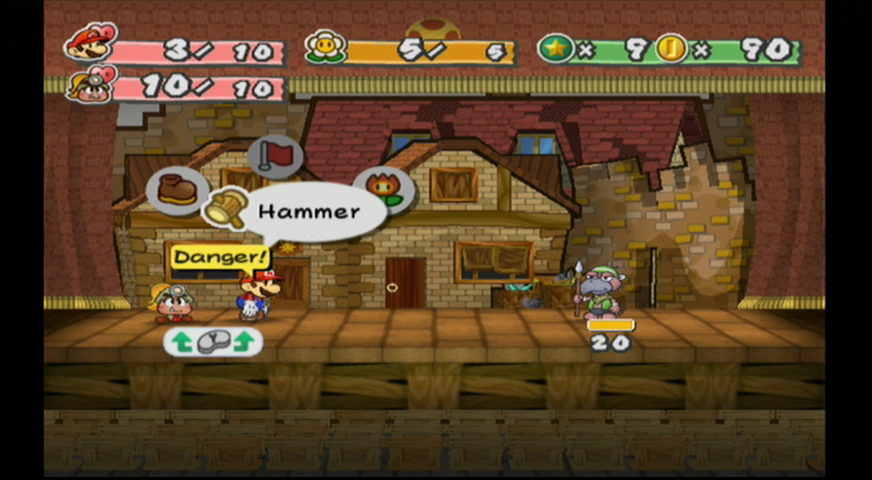
The gameplay is typical turn based JRPG combat, but with an additional skill-based “action/timing” mechanic that can boost your attack power or defense if executed correctly. For instance, pressing the A button just before Mario is hit by an enemy will decrease the damage he takes. Or if you’re feeling bold, you can try to press the B button before an enemy attack to counter and inflict damage on the enemy, but the required timing for pressing the B button is more precise. Mario can be assisted in battle by several companions that he encounters throughout the story. Each companion has their own stats and skill set and can also be upgraded by finding hidden items throughout the game. Each time Mario levels up, you can either increase his HP (Heart Points), FP (Flower Points, required for special attacks) or BP (Badge Points). Badge points are probably the most interesting to upgrade because they allow Mario to equip badges that grant him extra abilities. For example, you could equip the Double Dip badge which allows Mario to use 2 items per turn, providing that you've already found the Double Dip badge and have enough BP to equip it.

The BP system keeps the battles interesting because you’ll constantly be experimenting with new badge setups in battle and the “action/timing” mechanic keeps you engaged trying to learn how to defend each enemies’ attack timings.The pacing is also excellent, you’ll never feel like you’re doing the same thing twice. One chapter has you entering into a wrestling tournament, while another has you solving a series of mysteries while riding a train.

Paper Mario: The Thousand Year Door Video Review

Summary:
The only drawbacks I can think of with this game are with the difficulty. It’s pretty easy. It’s more of an intro to RPGs, so if you’re used to playing these kinds of games, you’ll probably breeze through it. Also the game starts a bit slow. The first two chapters, compared to the rest, are kind of bland. But stick with it, the game gets better the father into it you get. I think it’s worth tracking down a Gamecube and a copy of this game to play it. Or if you know me personally, ask me and I’ll let you borrow my copy. If you only take one of my recommendations seriously, let it be this game

Friday, February 14, 2014

Uncharted 2: Among Thieves

Naughty Dog - 2009 - PS3

A copy of The Last of Us has literally been sitting, unplayed, on my TV shelf for the last 3 months because of Uncharted 2. Not because I've been busy playing Uncharted 2, but because I finished Uncharted 2 a couple years ago and it had to be one of the most overhyped and uninteresting games I think I've ever played. Don’t get me wrong, I don’t think Uncharted 2 is a bad game, but I don’t quite understand how it won over so many critics and sold so many copies.

The platforming sections are slow and unremarkable. The puzzle solving sections are too simple and usually just involve opening Drake’s notebook to the proper page to find the solution. The cover based shooting is just… cover based shooting. There’s nothing new here, this game retreads ground that many other games have already tread. By the way, I really hope you like cover based shooting because there’s A LOT of it here. Granted, I played Uncharted 2 immediately after finished the first Uncharted, so I might have burned myself out on Uncharted.

But I think the issue is deeper than that for me. I think I’m burned out on shooters. If the 90s were the era of the platformer, the 00s are definitely the era of shooters. I think I’m just bored and ready for something else. Modern shooters have to do something else interesting in order to hold my attention. Tell an interesting story. Layer an interesting mechanic on top of the shooting. I don’t think I can handle any more pure shooters though. Not that Uncharted is a pure shooter, but it feels close enough. The story feels like a script to a typical Hollywood action movie, it’s kind of forgettable and bland. I never felt invested in the story at all or any of the characters in it for that matter. Nathan Drake comes across as very smug and cocky to me which really started to rub me the wrong way after a while. I feel like the player should never be put off by the character he’s controlling unless it’s intentionally comedic or something.

Summary:
There’s really nothing about this game that I found warranted the praise and acclaim that it got at its release. I guess it does look really graphically impressive, but that usually never matters me especially if the game itself isn't that fun. I’m hoping none of the things I've just described are true about The Last of Us, but I've yet to work up the nerve to try and play through that game.

Friday, February 7, 2014

Final Fantasy V

Squaresoft - 1992 - SNES/PS1/GBA/iOS/Android

See Also My Top 10 Final Fantasy Games List

(Author's note: This review was initially posted on 2/17/2014 and was rewritten on 9/25/2015. You can read the initial review below as a comment)

I have somewhat of a soft spot for old school turn-based JRPGS, and this is one of my favorites. FFV tragically gets overlooked quite a bit because it didn't have an official U.S. release/translation until 1999, seven years after it came out. This is really a shame because I think FFV outshines the other SNES era Final Fantasy games in a lot of ways. I'm sure this is a controversial opinion as debating which games in the Final Fantasy series always tends to get heated, but if you don't believe me and you haven't played this game, you really should.

FFV's story is kind of... ehhh. It's pretty standard template "heroes save the world" writing. Story is not where this game shines, but pretty early in the game, you’ll unlock FFV’s job system. FFV's job system is what sets this game apart from other Final Fantasy titles, for better or for worse. The various jobs are slowly unlocked at key story points as you progress through the game. You initially unlock knight, monk, thief, white mage, black mage and blue mage but will eventually unlock all 21 jobs (25 in the enhanced remake). You can assign any of your 4 party members any job and can reassign them at any time. Changing jobs will affect your character’s stats and what items they're able to equip as well as grant them different abilities to use in battle. Once you master a job’s ability you can carry it over to use with other jobs. This, to me, is where FFV is at its best. Trying to figure out which combinations of jobs and abilities were powerful and which were useless was really fun and rewarding. For instance, combining the Ninja job's "dual wield" ability with the knight class' high innate defense and ability to equip high damage longswords was pretty good if my memory serves. FFV is paced pretty well such that you'll unlock more jobs just as you were mastering previous ones so you always have new combinations and tricks to try out and experiment with. The ending of the game comes right about the time you've mastered enough jobs to be dangerous. Unleashing all of your ridiculous tricks and crazy combinations on the final boss feels like an adequate final exam of your mastery of the job system.

I think FFV is one of Nobuo Uematsu’s first really excellent soundtracks . Not that any that came before were inferior, but FFV really showcases Uematsu's musical range and his ability to create timeless and catchy tunes one right after the other, over and over again. “To the North Mountain”, “Home, Sweet Home" and "Clash on the Big Bridge" are some of my favorite tracks.

Summary:
If you enjoy old school RPGs or are a FF fan who missed out on this game the first time around, you should check this game out. If you don't mind the slower pacing of the turn-based combat, I've found experimenting with FFV's job system while listening to the genius of Uematsu to be a really enjoyable experience

Friday, January 31, 2014

Elite Beat Agents

iNiS - 2006 - DS


Oh man, this game. Elite Beat Agents is a music/rhythm game for the Nintendo DS. Gameplay in EBA consists of tapping and sliding the DS stylus on the screen when the game prompts you in time with the music. It’s kind of like Guitar Hero but without the guitar. That may sound easy to you, but on faster songs with a lot of beats, the screen can fill up with a lot of beats and it becomes hard to hit them all in the correct order and with the proper timing. I found myself doing better on songs I had heard before so I could sort of use the rhythm as a guide. Nearly all of the songs in the game are pop songs, but I really don’t listen to much popular music.

The gameplay in EBA is fun in the same sort of way Guitar Hero is fun, but the real draw of EBA is the absolute lunacy of the games’ “story”. Now I looked this next part up on Wikipedia, cause the game doesn't really straight up tell you what’s going on, but the “story” of EBA is that there is a government agency that dispatches special elite dance agents to help people when they’re in trouble. The agents don’t actually directly assist people with their issues, but rather they dance to motivate and inspire people to overcome their problems. Each song in EBA is accompanied by a humorous short story about a person or people in peril that apparently need dance inspiration to overcome issues. It’s really goofy and silly in a very bizarre way. The closest thing I can draw a comparison to is the humor in the WarioWare games.

Summary:
If you like rhythm games or games with a really wacky sense of humor, check this out. It’s short and I’m not sure how much replay value it has, but it could be an interesting way to kill some time on the go.

Friday, January 24, 2014

Silent Hill 2

Konami - 2001 - PS2/PS3/Xbox/X360/PC

I was thinking a bit about how I railed against Journey and Brothers for having gameplay that isn't “fun”. The strength of those games lies in their unique storytelling methods. Then I realized one of my favorite games kind of falls into that same boat. Silent Hill 2 is a classic survival horror game and one of my all time favorite games. Don’t worry about playing Silent Hill 1 before 2 or anything like that. 2 has very little to do with 1 other than the setting of the game being the same.

Silent Hill 2 a psychological horror game, not an action horror game like most modern horror games. Think Amnesia as opposed to Left 4 Dead. In Silent Hill 2, you’ll play as James Sunderland who has just received a cryptic letter from his wife telling him to meet her in the town of Silent Hill. The only thing is that James’ wife has been dead for 3 years. So you’ll explore the town looking for clues as to why you received a letter from a dead person.

This game is not fun to play. It’s really not, at least not for me. The game rarely gives you ammo for your weapons, so you’ll spend most of the time running away from monsters and stressing about ammo conservation than shooting them. And being lost in the town, which will probably happen a few times to you, is kind of frustrating. But these two mechanics are included by design and are how the player is supposed to feel. At least I believe that’s what the designers intended for the players to feel.

A lot of this game’s design and story elements may seem random and coincidental at first, but after finishing the game, I looked back and realized quite the opposite. The story is very tight, and even some of the smallest details I first thought to be random turned out to have strong meaning and relevance. It’s one of those games that I kept thinking about days after I had finished it, just mulling over the story and realizing how every little detail fell into place to make a complete narrative. This game does a masterful job of communicating narrative elements through gameplay, through symbolism and through level design. It’s an experience that’s completely unique to the medium of video games, and I've never really played anything that communicated ideas like that before or since.

Summary:
My main knock against this game is that some of the puzzles feel kind of tacked on and out of place and why dear god why is there not a mini-map..? But if you can handle the frustrations of a slower paced game and are a fan of psychological horror, Silent Hill 2 is a memorable game to experience. It also has an excellent soundtrack if you’re into ambient music

Friday, January 17, 2014

The Swapper

Facepalm Games - 2013 - PC

Where was this on everybody’s “2013 game of the year” list?? As of this writing, it’s January 2014, so all of the major game websites have put out their “best games of 2013 list”. I've checked most of the major gaming websites, and this game has appeared on precisely none of the “best game” lists, whereas games like Brothers and Bioshock Infinite - both of which I found to be less than favorable - appear all over the place. I don’t understand. Anyway, The Swapper is an indie puzzle game which has taken quite a bit of influence in its art direction from the Metroid games. Actually, this game threw me quite a bit at first. After seeing all of the visual and stylistic references to Metroid, I was expecting a Metroidvania game. The Swapper is very much just a puzzle game and nothing more, but it’s a very good puzzle game.

The main puzzle solving mechanic in the game is the title device, The Swapper. It allows the user to make clones of themselves that will mimic the user’s actions one to one. It also allows the user to transfer their consciousness not only between their clones, but between any living being, which makes for some interesting storytelling. Armed with The Swapper, you’ll explore a derelict space station that has been seemingly mysteriously abandoned. You’ll solve puzzles and read crew logs to try to piece together what happened to the station.

Summary:
The puzzle design in this game was pretty excellent, on par with games like Portal or Braid, where I would just stare at the screen for minutes at a time and try to think through what I needed to do to complete the puzzle. Light plays an important role in this game’s puzzles. Blue light will block The Swapper’s cloning feature where red light will block the “swapping” feature. Purple light will block both. The game’s mechanics are a bit difficult to illustrate verbally, so you may want to check out some gameplay videos to get the idea and see if this interests you. Don’t be thrown by the Metroid references, this isn't that kind of game. But if you enjoy puzzle games, The Swapper is a must-play.

Friday, January 10, 2014

Brothers: A Tale of Two Sons

Starbreeze Studios - 2013 - PC/PS3/X360

I saw this game come up several times on various “best games of 2013” lists across the internet, so I figured I needed to check this one out. Brothers is a short indie game where you guide the title characters on a quest to save their dying father by collecting an antidote from a far away place. It’s kind of got a dark European fairytale thing going on too, if that does anything for you.

Brothers is one of those games that kind of defies genre classification. It’s kind of story driven, it’s kind of a platformer and it’s also got some basic puzzles in it, but I didn’t think it did any of those things particularly well. You’ll control the two brothers simultaneously: the older brother with the left joystick and the younger brother with the right joystick. Oh by the way, this game requires you to play with a controller. I thought this game may do some interesting things with puzzles by requiring the player to move the two characters asynchronously or something like that, but not really. One of the most difficult things in this game is just trying to navigate the brothers down the path when your thumbs wont coordinate with each other.

Summary:
The one thing I did like about Brothers is that it did an excellent job of storytelling and conveying emotion without a single line of dialogue. I love when games do that well. Brothers is not a bad game par se, but it’s certainly wouldn’t be on my “best games of 2013” list. Brothers actually reminded me quite a bit of Journey in that most of the gameplay is simply navigating through the environment and just kind of watching things happen. Also both of those games implement storytelling without dialogue. Also I didn’t care much for either of those games. Their stories, while well delivered, just aren’t that interesting to me. And their gameplay is, well, just not that much fun. But I have a feeling that the same people who loved Journey will be the same people who will enjoy this game. It’s just not my thing, I guess

Friday, January 3, 2014

Spelunky

Derek Yu - 2009 - PC/X360/PS3/Vita

Spelunky is an extremely difficult indie Roguelike platformer. It’s Roguelike in that all of the levels, terrain and enemies in the game are randomly generated, which helps keep the game fresh and interesting. It reminded me quite a bit of Rogue Legacy with its excellent design and brutal difficulty.

The object of each level in Spelunky is to get to the exit, but you’ll have to navigate through lots of traps and other enemies in a randomly generated level. Your character will start with a limited supply of bombs and ropes to help you navigate the level. Bombs can be used to destroy terrain and dig deeper while ropes can be used to help you climb back up. You don’t always want to just race to the exit when you find it either, you’ll want to explore the level and gather as much gold and upgrades as you can find before leaving. But if you spend too long in any given level, a giant ghost that can kill you instantly appears to chase you out of the level. There’s also a maiden hidden in each level. If you bring her to the exit, she will restore one point of your health, so you’ll want to try to find and rescue her in each level. You’ll find shops hidden in each level where you can spend your gold to replenish your bombs/ropes, and buy weapons and upgrades. Spelunky also features local co-op which is pretty fun, but still just as hard.

Summary:
It’s a very difficult game, but if you don’t get frustrated it’s a very addictive game as well. I've actually yet to make it past the third level in this game, but I've gotten close a few times. Check it out if you enjoy difficult platformers


Tuesday, December 31, 2013

Super Smash Bros: Project M

PMDT - 2013 - Wii

(On my Top 10 Favorite Games list)

(Author's note: I originally reviewed this game at the end of 2013 when Project M 3.0 first launched. The review contained some outdated information and I wasn't too happy with what I wrote begin with, so I rewrote it as of 9/21/2015. You can read the original review as a comment below)

What is Super Smash Bros: Project M? No, Nintendo didn't sneak in a fifth Smash title without you noticing, Project M is a fan-made mod of Super Smash Bros. Brawl for the Wii to make it play more like Super Smash bros. Melee for the Gamecube, hence the M in Project M. But this isn't to be confused with Nintendo's most recent Smash title, Super Smash Bros. for Nintendo 3DS and Wii U which fans have just taken to calling Smash 4 because the former is a mouthful. Confused yet? Let me start over from the beginning. In 1999, developer HAL labratory and Nintendo launched Super Smash Bros. for the Nintendo 64. It featured all of the most well known Nintendo mascots in a fighting party game where emphasis was on knocking the opponent off of the stage. There were no health bars in the game; there was only a damage counter. The more damage you dealt, the farther your target will fly the next time they're hit. Super Smash Bros, henceforth referred to by fans as Smash 64 to avoid obvious confusion with other Smash titles, was a critical and commercial success. It was intended to be a fun party game, but some people (myself included) enjoyed playing it with friends competitively with its wacky items turned off.

Then in 2001, Super Smash Bros. Melee for the Gamecube was released. It was amazing. It was more full featured, faster and had more depth than Smash 64. But more importantly, its game engine better facilitated the competitive playstyle that I enjoyed from the previous game. 15 years later, Melee still retains a large competitive audience and the Melee tournament scene is still active and growing. There's an excellent documentary on YouTube if you'd like to learn more about Melee and its top players, but we're here to talk about Project M - and I'm almost there. In 2008, Super Smash Bros. Brawl was released for the Nintendo Wii. It featured, by far, the largest playable roster of fighters, more stages and more items and a more fleshed out single player mode. It was a fine party game, but most fans of competitive melee didn't care for Brawl. The Brawl physics engine didn't allow for the fast-paced, combo heavy gameplay of Melee. Furthermore the perceived balance of Brawl's roster was so lopsided that one character, Meta Knight, started to be banned from use in some tournaments.

So now enter Project M. It was designed by a collective of Brawl modders now known as the Project M Development Team (PMDT) to be a complete overhaul of Brawl to make it play more like Melee, changing everything from the physics engine to character balance and movesets. Fighters from Melee were mostly reverted or approximated to their Melee counterparts while Brawl newcomers were reimagined in the Melee engine and in most cases given new animations, movesets and playstyles. New gameplay modes and features, new characters, and new stages were added as well. I think there's more that sets Project M apart from Brawl and the PMDT have made so many changes that in my eyes, Project M really is its own game and not just a mod of Brawl. It's relative ease of installation is also a huge plus, only requiring its users to have a copy of Brawl and an SD card with custom files (which you can find here for free) loaded onto the Wii. No other permanent modifications need to be made to the system or the game.

In addition to approximating the physics engine of Melee, Project M has several other features that benefit competitive play like built-in stage striking and debug mode with hitbox displays and a frame advance feature. So now some of you may be thinking "That's cool and all, but I have no interest in competitive play. Should I still check out Project M?" Yes. There's lots of really cool and unique new features in Project M that make it worth checking out on its own. Ever want to play a different character on every single stock? Project M's all-star vs. mode has you covered. Ever wanted to play Smash like a traditional fighting game with hit points and death boundaries turned off? You can do that too. If you really want to get ridiculous, check out Project M's turbo mode which allows any move you do to be on hit canceled into any other move.

The attention to detail is another thing that's really nice about this game. When character's movesets were being reimagined and tweaked to fit competitive gameplay, homages to the various series each fighter is from were worked in. For instance, Snake can now use his tranquilizer gun and survival knife from Metal Gear Solid, Lucas can use "Offense Up" from Mother 3, and Samus can switch between ice beam and fire beam, like in Metroid Prime. Brand new stages have also been created with a high level of fidelity and detail. Some even include cool easter eggs and other visual secrets. A brand new announcer was added to the game along with new music tracks and imported sound effects from Melee. Actually, if you're a little more technically inclined, it's not too hard to figure out how to replace the music files for the game yourself and create your own tracklist for this game.

Super Smash Bros. Project M Video Review

Summary
I really enjoy Project M. It's my personal favorite Smash game to play due to all of its competitive-friendly features and roster balance which the PMDT maintains through semi-frequent patches. I know Project M has been struggling to stay in the spotlight recently, due to the release and popularity of Smash 4 in conjunction with Nintendo sponsoring Twitch streams of Smash tournaments and obviously not having an interest in promoting a game that's not their own. But I hope the audience for this game will continue to grow cause I really enjoy playing it with other people. I'd say it's worth finding a copy of Brawl and dusting off your Wii if this looks interesting to you. It's a blast to play whether you're a competitive or casual player, newcomer or Smash veteran.


999: 9 hours, 9 persons, 9 doors

Chunsoft - 2009 - DS

Yet another interactive story game feeding my newfound love of games like this.. After playing Heavy Rain and To The Moon, I wanted more games like this and 999 delivers. 999 is probably what you’d get if you made the Saw movies into a Japanese Anime. And then made that into a video game.

In 999, your character wakes up locked in a room with no memory of how or why he’s trapped there. You’ll eventually escape the room to find that you’re one of 9 people trapped on an old cruise ship. You learn that you've been imprisoned by someone named “Zero” who wants the 9 of you to play survival game that involves solving puzzles to find a sequence of 9 hidden doors somewhere on the ship that supposedly lead to your freedom. The problem is that your party only has 9 hours to find the doors before you’ll all be dead, hence the title 9 hours, 9 persons, 9 doors. Sounds like something Jigsaw would cook up in one of the Saw movies except this game was made in Japan, so all of the characters are very anime looking and have ridiculous goofy looking colored hair.

The writing in this game is pretty strong. The characters are distinct and well developed and the story seems pretty well thought out. There are a few times where this game’s attempts at humor will fall flat, but it does a masterful job of creating and maintaining suspense throughout the story. It’s one of those games that will keep you thinking about the story even when you’re not playing it. The game is mostly just reading text and making dialogue choices, but there are a few puzzle solving sections as well. The puzzles usually involve searching a room for items or solving some simple math based problems. If you don’t figure out the puzzles on your first few tries, the game will automatically start providing hints until you understand what the game wants you to do, so you probably won’t ever be stuck on a puzzle in this game for very long.

I was really all set to love this game and start singing its praises - until I finished it. Based on some of the decisions and dialogue choices you make in the game, you will get one of several different possible endings when you finish the game. What broke my heart about this game is that you’re guaranteed to get a “bad ending” on your first playthrough. In order to get the “true ending”, you have to play through the game several times. Screw that. This is a narrative based game! That would be like reading through a book several times before you’re allowed to see what the “real ending” is. And it’s not just that there are “bad endings”, it’s that the bad endings leave so many loose ends and unanswered questions that are only given in the “true ending”. But I don’t want to re-solve puzzles I've already solved, nor do I want to re-read text I've already read. Ugh. I was so disgusted by the design choice here that I just looked the true ending up on the internet.

Summary:
What a shame, I would have really liked this game… Apparently there’s a sequel for this on 3DS, but I need to make sure they don’t repeat this forced bad ending crap before I check it out. If you can overlook this game’s flaws, it does tell a compelling story. Just expect to be disappointed at the end.

Batman: Arkham Origins

Warner Brothers Games Montreal - 2013 - PC/X360/PS3/WiiU


I think Batman needs to just give up on Gotham and find a city worth protecting. It seems like 99% of everyone you run into in Gotham is a criminal. I mean it made sense in the first game where Batman was in the asylum and all of the inmates had gotten loose. And I guess it made sense in the second game too, when all of Arkham’s residents had gotten loose again and taken over the city. But now in this game, aside from the fact that it’s Christmas Eve, it’s a normal day in Gotham city and the streets are still covered with criminals. Literally every single person you see on the street is either a criminal or a member of the SWAT team. Where are the normal citizens? Exactly who is Batman protecting here?

Anyway, Batman: Arhkham Origins is, as the title suggests, part of Batman’s origin story and takes place in the early years of Bruce Wayne’s career in crime fighting. It tells of Batman’s first encounters with characters like Killer Croc, James Gordon and, of course, The Joker. The game begins with the criminal organization leader known as Black Mask placing a 50 million dollar bounty on Batman’s head. Several B-list Batman villains, most of which I had never heard of before, show up in Gotham to try to take down Batman and collect the bounty. But then of course The Joker shows up and upstages all of the other villains. Sounds like a typical Christmas Eve for Batman.

This game was actually not made by Rocksteady, the studio that did the last two games, but by WB Montreal. If you don’t count the WiiU port of Arkham City (who does?), this is actually WB Montreal’s very first game, which made me a bit nervous to try it. You’d never know it though, the quality and polish of Arkham Origins is pretty high, so I suspect there were a lot of veteran developers brought on to the WB Montreal team. Actually, if I hadn't known the series had switched developers, I doubt I would've noticed at all; Origins is so similar to the other two games, especially Arkham City. A lot of the animations, game mechanics and even the models and assets from City seem to be copy/pasted into Origins, so I guess Rocksteady gave WB Montreal access to their source material.

There’s really not much new introduced in this game either, which I guess is a bit disappointing, but I had been meaning to replay Arkham City anyway and this was a nice way to do it - with a different narrative layered over the pre-existing gameplay. Actually, just about the only noticeable difference between Origins and City is the change in voice actors. I was disappointed to not see the actors from the animated series and the other games return to reprise their roles, but the new actors do a fine job. The new Batman actor does a younger and angrier emulation of Kevin Conroy’s Batman and the new Joker’s portrayal is a bit more edgy and dangerous feeling than Mark Hamill’s Joker. Different, but still good.

Summary:
This game is quite similar to Arkham City and what you thought of City will likely be the same thing you think about Origins. I had fun with this game, so check it out if you were a City fan.

The Legend of Zelda: A Link Between Worlds

Nintendo - 2013 - 3DS

See also my Top 10 Zelda Games list

There’s really only two video game franchises I’m a diehard fan of. I've played pretty much every Final Fantasy (except the MMOs) and I've played pretty much every Legend of Zelda game (except the DS ones). As mentioned in my Pokemon review, I have handheld-phobia which is why I haven’t bothered to play Spirit Tracks or Phantom Hourglass yet, but after finishing Pokemon X, I had confidence enough to try A link Between Worlds. My favorite entries in the Zelda franchise have been the 3d ones (Ocarina, Majora’s Mask and Wind Waker), but A Link to the Past is the only other game I've bothered to play through multiple times. So I was excited to play a direct sequel to that game. By the way, as long as Nintendo is doing direct sequels to games in their franchises, can we get a Majora's Mask sequel? Or at least another Zelda game with a weird and dark tone like that game had?

Love that game… Anyway, if you’re a Link to the Past fan, this game is going to feel very familiar. Music, sound effects, locations. Actually, about 5 minutes into the game, I realized they had copy/pasted the world map from the original game. I haven’t gone back to A Link to the Past to see if it was totally 100% copy/pasted but it’s pretty darn close. Your house, Kakariko Village, Hyrule Castle and everything else is right where it was on the SNES. Actually, some of the boss fights are completely copy/pasted from A Link to The Past, which I’m actually okay with. It’s usually not rocket science to take down a Zelda boss. Just stab whatever’s glowing, and if that doesn't work, cycle through all the items in your inventory till you find something that does. So I don’t think it really spoils anything when this game pays homage to the classic game’s bosses. If you've never played A Link to the Past, I still think you’ll get a lot out of this game, but you just won’t get all of the cool references to its predecessor.

What makes this game differ from other Zelda games is that you can rent every piece of equipment from nearly the beginning of the game. But if you die, you lose all of your equipment you had. That is, unless you purchase it, but purchasing equipment is way more expensive that renting it. Also the dungeons in the game can be explored and taken in any order since there’s not a linear progression of obtaining items. This was an interesting change and they definitely pulled it off, but I’m not sure if I personally liked it or not. It’s just different.

Where this game really excels is in the puzzle design in the dungeons. The solutions to the puzzles are almost always “AH HA!” than “What? Really??”. Whereas I felt the opposite to be true in some of the recent entries in the Zelda franchise. Actually, I think this is some of the best puzzle design in any of the Zelda games. The 2d/3d wall painting thing works really well as a puzzle solving mechanic and there are a lot of really good design choices made on all of the mechanics and puzzles found in the game.

Summary:
Overall, I found A Link Between Worlds to be a very solid Zelda game and although I haven’t played Spirit Tracks or Phantom Hourglass, it’s my favorite Zelda since Wind Waker.

Papers, Please

Lucas Pope - 2013 - PC

This may have been the most unique game I played this year. In Papers, Please, you play a immigration clerk screening immigrants for potential entry into the fictitious country of Arstotzka. Immigrants give you their paperwork and it’s up to you to process and find any discrepancies in their papers.

At the end of the day you’ll have to choose how to spend your very small paycheck - on feeding your family, paying the heat bill, or providing your children their medicine. And you probably won’t have enough money for all of it. You’ll want to process as many immigrants as you can as quickly as possible, because you’re paid by how many you process per day. But you don’t want to go too fast or you may miss a discrepancy in their paperwork and have to pay a fine. It’s kind of a nerve wracking and depressing game to play. But I don’t mean that as a negative criticism of the game, it was clearly designed to invoke those kinds of emotions. You really get the feeling of what it’s like to be a desk clerk doing a menial but stressful job and getting paid next to nothing for it.

Summary:
It’s an interesting and unique indie game. It’s not my favorite, but it’s certainly different, which is always good.

To The Moon

Freebird Games - 2011 - PC

So in the distant future, we apparently have the technology to alter people’s memories. To The Moon focuses on Dr. Neil Watts and Dr. Eva Rosalene, two memory traversal scientists who work for a company that uses memory altering technology to grant dying clients their last wish. Watts and Rosalene are hired by Johnny Wyles, an old man on his deathbed whose dying wish is to go to the moon.

You alternate control between Watts and Rosalene as you travel through Mr. Wyles entire life’s memories while you try to implant a memory of him going to the moon. If you hadn't guessed by the description so far, this is another narrative focused game. Actually the gameplay is somewhat analogous to Gone Home where advancing to the next scene in To The Moon requires examining different objects in the scene to determine if they’re relevant to the story or not. There’s also a few very simple puzzle solving bits in To The Moon, which I felt weren't really that fun and ultimately didn't add much to the game.

But man, the writing in this game was tight. This is a game that really “worked” for me in contrast to Gone Home. I found the characters relatable, interesting and very well defined, and once you get a feel for who all the characters are, the game keeps you interested by teasing you with the mystery of why Mr. Wyles dying wish is to go to the moon. This game conveys emotion with storytelling and music as well as any other game I've played, and it’s use of humor and comedic timing got me to laugh out loud a few times. The game’s tone alternates between humor, mystery and tragedy and touches on the themes of love, life and death. It borders on being overly sappy sometimes, but I found this game to be a pretty interesting commentary on life and human interactions told through a unique perspective of two people viewing a stranger’s life’s memories. I hear the creators are working on a sequel now that should be out soon, which I can’t wait to play.

Summary:
Again, there’s not much “game” to be had here, but if you want an excellent interactive story, check this out. It’s good stuff.

Tactics Ogre

Quest - 1995 - SNES/Sega Saturn/PS1/PSP

One of the coolest SNES games you've probably never heard of, Tactics Ogre was first released on the SNES in Japan in 1995. Actually, it was never officially released in the U.S. until it was ported to the PSP a few years ago. But your best bet to play this game is probably a SNES emulator with one of the fan-translated ROMs, because no one I know actually owns a PSP.

Tactics Ogre was made by largely the exact same team of people that worked on Final Fantasy Tactics. Same director, same story writer, same composer and (some of) the same artists. This game will feel very familiar if you've ever played FF Tactics. I realize now that some of the battle scenarios and story scenarios for FF Tactics were lifted straight out of this game. If you've never played FF Tactics, Tactics Ogre is a turn based strategy game kind of like XCOM: Enemy Unknown. One of the cool differences in this game is that there are decision-based branching story points. I’m not sure why they went away from that for FF Tactics.

I really want to like Tactics Ogre more, but there are a few gameplay issues present in this game that weren't fixed until FF Tactics that make this game pretty annoying. Firstly, this game is hard. Like stupid hard. Like evil hard. Which isn't bad, but when you combine that with a permadeath mechanic where your units instantly die, it feels unfair. In FF Tactics when a unit’s HP hits zero, it begins a 3 turn timer where that unit is bleeding out and can be revived. They only will die when the timer hits 0. In Tactics Ogre when a unit’s HP hits zero, they’re dead instantly. So many ragequits. So many battles restarted. You’ll eventually get a class that can bring back units who have died in a battle, but it’s not until way late in the game.

This game is also way more grindy than FF Tactics. There were a few battles where I realized I wasn't even close to winning and had to level up my units for a bit before retrying. And like most RPGs, grinding in Tactics Ogre is not that much fun.

Summary:
If you want to try an obscure tactical RPG with some old school difficulty, you could do worse than Tactics Ogre.

The Stanley Parable

Galactic Cafe - 2013 - PC

I loved everything about this game. Loved it. If I had to pick a “Game of the Year”, Stanley Parable would probably be it, since FTL technically came out last year. I only wish this game were longer. I want a 20-30 hour version of this game. You’ll probably be done with this game in about 5 hours or so.

This will be another difficult one to talk about without spoiling anything, but The Stanley Parable is kind of a “choose your own adventure” with a narrator that describes all of your choices. You’ll likely keep restarting the game even after you've gotten an ending just to see what the other endings are. The game has a fantastic sense of humor and frequently breaks the 4th wall and pokes fun at video game tropes. The writing is excellent. Some endings will make you laugh, others will make you think. My favorite endings do both.

Summary:
I would recommend this to nearly everyone, just know that it’s unfortunately pretty short.

Pokemon X/Y

Game Freak - 2013 - 3DS

This was the first Pokemon game I had really gotten into since Gold/Silver, so a lot of the gameplay mechanics were new to me. I actually played a bit of Black/White earlier in the year, and it didn't click with me, so I was a bit nervous about playing X/Y. I was also a bit nervous to play this because I just don’t like playing on a handheld system. I don’t like being hunched over staring at a tiny little screen when I could just as easily lay back on my couch and watch a giant TV. I don’t have a need or desire to carry around a 3DS with me and play games on the go, so the entire concept of handheld gaming is a bit off putting to me, so I really had to make a focused effort to play this game despite its hardware. It was actually the first handheld game I had completed probably since I was a kid, and I actually found it kind of nice to play this while watching a football game on TV and battle between commercials and what not. Anyway, back to talking about the actual game.

If you've ever played a Pokemon game before, it’s really the same basic cake, only with a lot more icing on top. If you didn't like the cake to begin with, you probably aren't going to like it now. But for people who do like the original Red/Blue cake, the X/Y icing tastes pretty good. And if you've never played a Pokemon game before, X/Y probably isn't a bad place to start. They've streamlined the battling and made it way less grindy. In terms of gaining experience, it no longer really matters who the lead Pokemon is in a battle since all Pokemon in your active party will gain experience. I found this to be a really nice change that makes the game more about strategy and less about grinding. They've also added a lot of extra layers on top of the basic rock-paper-scissors battle system. There are passive abilities, equippable items, mega evolutions and more. I know some of that stuff was added in previous generations, but it was all new to me.

They've also finally successfully integrated the internet into a Pokemon game in the year 2013, which is really nice. You can trade/battle with friends or strangers pretty easily now. They've even added a kind of Pokemon auction house, where you can ask for certain pokemon of a specific level or with specific properties or you can post your own Pokemon up for trade. I think my favorite new system was “wonder trade” where you trade pokemon with a complete stranger without knowing what you’ll get in return. It could be a pidgey or it could be a gyarados. It’s probably going to be a pidgey though.

My main gripe against this game would have to be the difficulty. I know this game is marketed for kids, but man this game was easy. I breezed through most of it without really having to think too much. I don’t remember Red/Blue being quite this easy, so I think they could have easily dialed up the difficulty a few notches. I think what could really make an amazing Pokemon game is if they actually spent a few seconds constructing a decent narrative. It’s still pretty much just go out and battle Pokemon because… because Pokemon.

Summary:
Still a pretty solid game though, and battling with 3d Pokemon models rather than 2d sprites was pretty nice.